Image classification Iceptionv3
Image classification Using Pretrained inceptionv3 Model
Libraries:
- TensorFlow and Keras
- Pandas
- Matplotlib
View the Project on GitHub SindujaSivan/pretrained-inceptionv3-image-classification
Project Objective: Image Recognition and Classification
Objective Summary: The objective of this small project is to create a simple image recognition and classification system. The system will take a set of images as input, use a pre-trained deep learning model (InceptionV3) to recognize and classify objects in the images, and then display the images along with their predicted classes and probabilities.
Libraries Used:
- TensorFlow and Keras: Used for deep learning, particularly for image classification tasks.
- Pandas: Used for creating and displaying results in a tabular format.
- Matplotlib: Used for visualizing images and their predictions in a grid layout.
Execution Process:
- Load Pre-trained Model:
- The project starts by loading a pre-trained deep learning model (InceptionV3) using TensorFlow and Keras. This model has been trained on the ImageNet dataset for image classification.
Input Folder Images
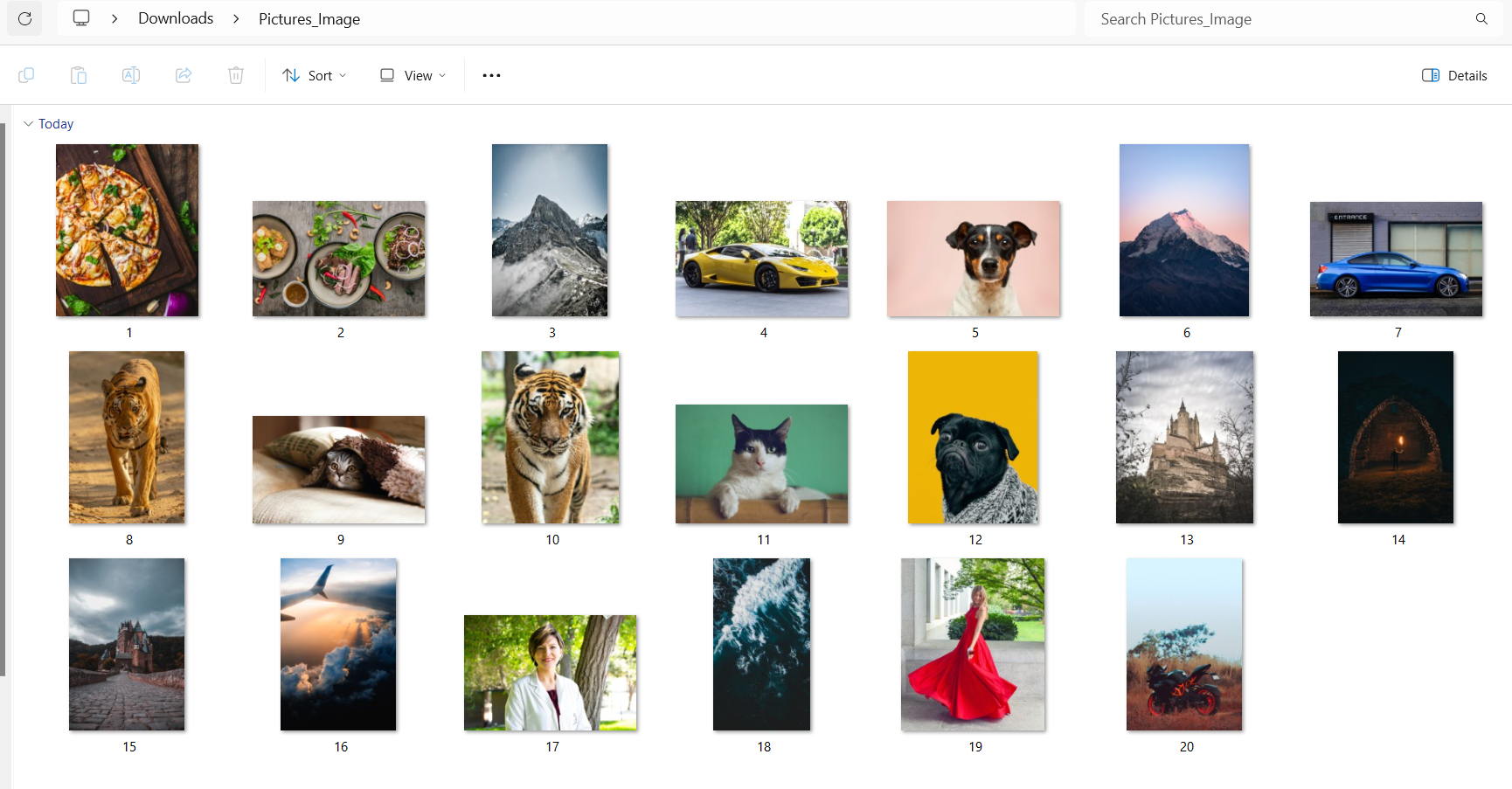
- Image Processing Function:
- A function (
recognize_and_name_items_in_folder) is created to process a folder of images. This function does the following:- Sets up a subplot grid for displaying images.
- Iterates through each file in the specified folder.
- Checks if the file has a valid image extension (jpg, jpeg, png).
- Attempts to load and preprocess the image using the InceptionV3 requirements.
- Makes predictions using the pre-trained model.
- Displays the image and its predictions in a subplot.
- Appends the results (filename, prediction, probability) to a list.
- A function (
- Error Handling:
- The code includes a try-except block to catch and print any errors that might occur during image processing. This helps in identifying and addressing issues with specific images.
- Results Tabulation:
- The results (filename, prediction, probability) are collected in a list during image processing.
- A Pandas DataFrame is created from the results list, providing a tabular view of the predictions.
- Display Results:
- The Pandas DataFrame is printed, displaying the predictions in a tabular format.
- The matplotlib library is used to display the images and their predictions in a consolidated grid layout.
Results:
- The final output includes a tabular view of predictions using Pandas DataFrame.
- Images along with their predicted classes and probabilities are displayed in a consolidated grid layout using Matplotlib.

Project Summary: This small project provides a straightforward implementation of image recognition and classification. It’s a useful starting point for understanding how to use pre-trained deep learning models for image-related tasks, and it can be expanded upon for more complex projects involving custom models, larger datasets, and additional functionalities.
Additional Information on Inception V3
InceptionV3 Model: Overview and Architecture
1. Introduction: InceptionV3 is a deep convolutional neural network architecture that was developed by Google researchers. It is part of the Inception family, which is known for its innovative use of inception modules. The InceptionV3 model is specifically designed for image classification tasks and has been widely used in various computer vision applications.
2. Inception Modules: The key innovation of the Inception architecture lies in its use of “inception modules.” An inception module is a block of layers that processes the input in parallel through filters of different sizes and then concatenates the outputs. This allows the network to capture features at multiple scales and resolutions in a computationally efficient manner.
3. Architecture: InceptionV3 builds upon the success of its predecessors, Inception and InceptionV2, by introducing additional improvements. Here’s an overview of the architecture:
- Input Layer:
- The input to InceptionV3 is typically an image with dimensions (299, 299, 3), representing a 299x299 pixel RGB image.
- Stem Network:
- The initial layers of InceptionV3 form the stem network, which is responsible for processing the input image.
- Inception Modules:
- The core building blocks are the inception modules, which are stacked on top of each other. Each inception module consists of multiple parallel convolutional branches with different filter sizes.
- Reduction Blocks:
- Between some of the inception modules, there are reduction blocks that include layers like max pooling and convolutions to reduce the spatial dimensions of the feature maps.
- Fully Connected Layers:
- Towards the end of the network, there are fully connected layers that transform the high-level features into class probabilities.
- Output Layer:
- The output layer typically has 1000 nodes, representing the predicted probabilities for each class in the ImageNet dataset.
- Activation Function:
- ReLU (Rectified Linear Unit) activation functions are used throughout the network, except for the output layer, where softmax activation is often employed for multiclass classification.
4. Transfer Learning: InceptionV3 is often used as a pre-trained model for transfer learning. Transfer learning involves using a model trained on a large dataset (like ImageNet) and fine-tuning it on a smaller dataset for a specific task. This is particularly useful when the target dataset is not large enough to train a deep neural network from scratch.
5. Applications: InceptionV3 has been successfully applied to various computer vision tasks, including image classification, object detection, and image segmentation. Its versatility and efficiency make it a popular choice in the deep learning community.
6. TensorFlow Implementation:
InceptionV3 is available in TensorFlow through the tf.keras.applications.InceptionV3 module. You can load the pre-trained weights or train the model on a custom dataset based on your specific requirements.
In summary, InceptionV3 is a powerful and efficient convolutional neural network architecture designed for image classification tasks. Its use of inception modules allows it to capture multi-scale features effectively, and its transfer learning capabilities make it valuable for a wide range of computer vision applications.